
One reality. Every asset. Connected.
Your model, your asset records, your maintenance history and the site itself all tell a slightly different story. Matrise™ brings them into one environment you can step inside.
Coming January 2027
What Matrise is
Nobody is missing data. The problem is that it lives in four places and none of them have agreed since the day construction ended. A shutdown gets planned against records that are out of date, a clearance gets confirmed by sending someone to site, and a technician spends the first hour finding the pump. Matrise closes that gap.

What Matrise Does

Your whole site in one view
Stop hunting for the right record. Matrise opens on your entire property in 3D, with every scanned location marked and ready to enter. Get your bearings on an unfamiliar site in seconds, check a distance across the yard, or find the area you need without calling someone who has worked there twenty years. Everything about the site starts from one place instead of four.

Step inside any location
That trip to site to look at one thing? Take it from your desk. Click a marker and you are standing in that space, seeing it exactly as it was captured. Look wherever you want, as many times as you want. Bring the designer, the vendor and the insurer along without any of them booking a flight or filling out a safety orientation.

Record it, hand it off
A problem found is worth nothing until the right person acts on it. Drop a pin exactly where the issue sits, add a note, a priority and an owner, and Matrise ties it to the specific piece of equipment it concerns. Export the set as a buildingSMART BIM Collaboration Format (BCF) file that opens in the software your team already runs, so it arrives as a tracked item with a location attached, not a description someone has to go looking for.
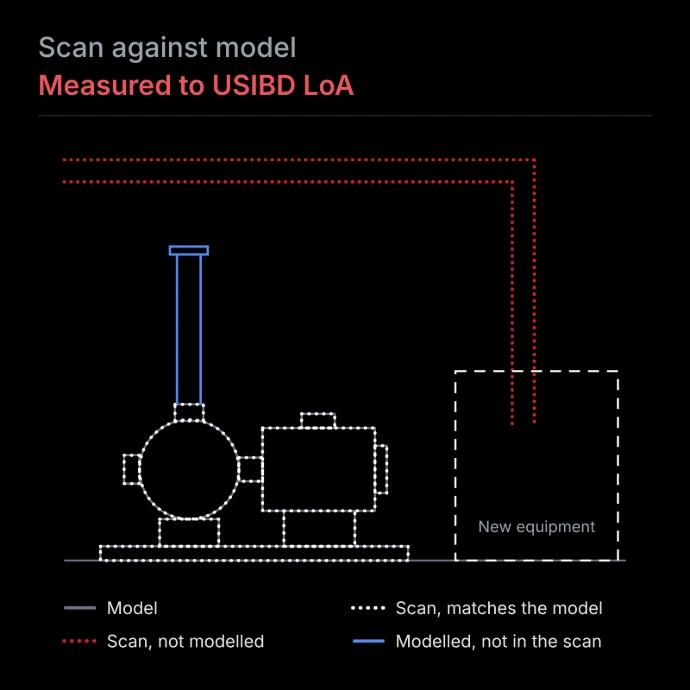
See where reality and the model part ways
Matrise colours the space by how far the real facility differs from the model. Red is something physically there that was not modelled, the pipe run added in 2011 that your new equipment is about to hit. Blue is something in the model that does not exist in reality. Set the tolerance against U.S. Institute of Building Documentation (USIBD) Level of Accuracy (LoA) standards, and every discrepancy in the scanned area is measured and on record before it costs you a shutdown.
What Matrise Runs
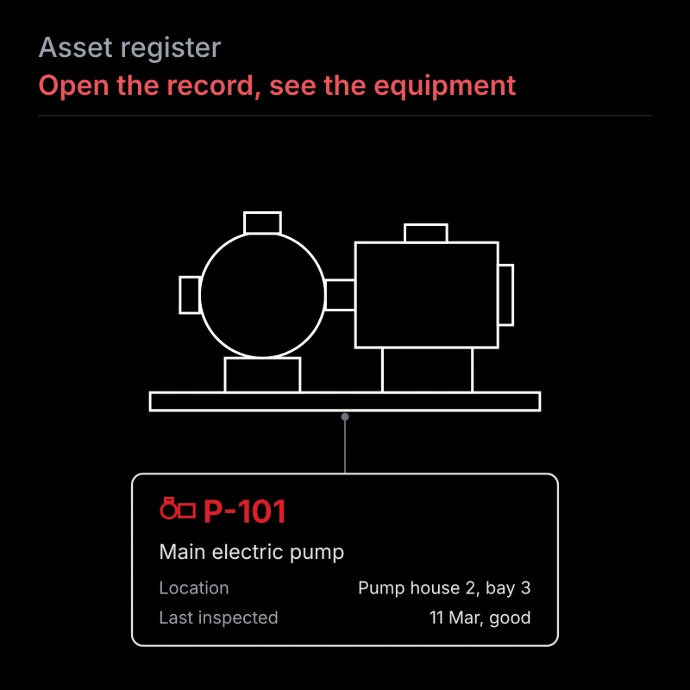
Every asset, where it actually is
A tag number tells you what to look for, not where to find it. Every asset in Matrise is tied to its place in the facility: the model element, the scan where you can see it, its documents and its maintenance history. Import an existing register from a spreadsheet, and assets carrying model IDs link themselves. Export it in COBie when the next system needs it.
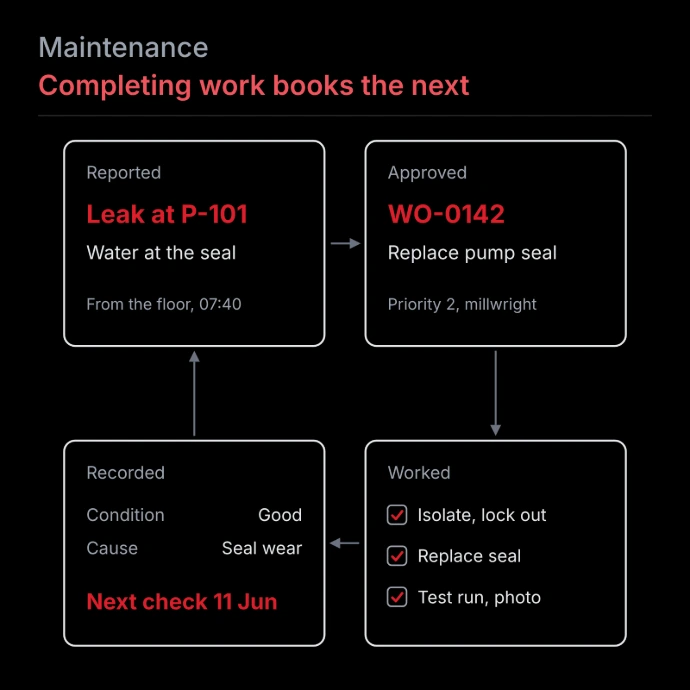
Maintenance with the facility attached
Enter the manufacturer's intervals once and preventive work schedules itself. Problems reported from the floor wait for approval, then go to a trade or a named technician with the checklist, isolation point and parts attached. Every inspection records condition, failure cause and photos, and books the next one. Records are added to, never overwritten, so compliance reports stand up.
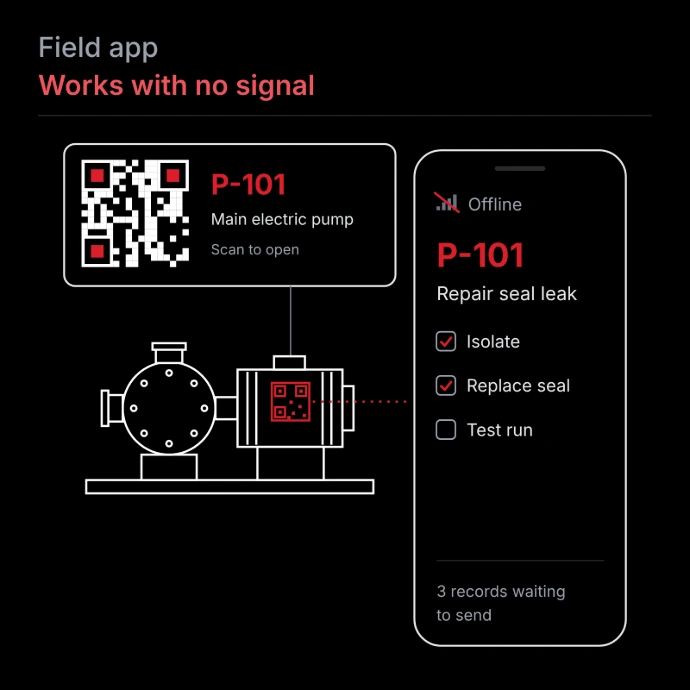
Work done where the work is
Technicians use their own phone app. It works without signal and sends everything when it reconnects. Scan the QR label on a piece of equipment to open its record or report a problem. New and urgent work arrives as a notification, and outside contractors get a link to their one job instead of an account.
Why Matrise
Your data stays yours
Some platforms are built so you cannot leave. Your facility ends up locked in a proprietary format and expensive to walk away from. Matrise runs on open standards, so what goes in can come back out. If you ever move on, you take everything with you, in formats anyone can open.
Nothing to install
No servers to set up and no IT ticket. Matrise runs in a browser. Send a link and whoever opens it lands on the exact view you were looking at, from a desk or a site trailer. Technicians add the field app to their phone from a link the same way.
Built to grow
Most digital twin projects stall because the data underneath them was never accurate to begin with. Matrise starts with a measured, verified record of the facility and runs your asset register and maintenance on it from day one. When you connect sensors or live operational data, they attach to something already correct and already in daily use.
Who it is for
Modelling and scan-to-BIM teams
Model review usually means jumping between the scan in one program, the model in another, and a list of comments in a third. Matrise puts all of it in one browser window. Check any element against the scan it came from, flag what needs work where it sits, and give your client a stated level of accuracy they can verify themselves. Faster QA, cleaner handover, fewer revisions.

Facility owners and operators
Your records are thorough. They are also spread across systems, and none of them let you actually look at the plant. Matrise captures the facility exactly as it stands and puts it in a browser, so the asset becomes something you can open and walk. Scope a shutdown once and have every contractor bid the same conditions. Check access before you dispatch a crew. See inside a confined or hazardous space without sending anyone in. Get new hires familiar with an area before they set foot in it. And when a twenty year operator retires, what they carried in their head stays with the plant.
Maintenance and asset management teams
A work order system knows the asset number. It does not know where the asset is, what it looks like or what sits around it. Matrise keeps the register, the work and the facility together. Send a technician to a pump they have already seen on screen. Plan a job against the space as it stands. When an inspector or insurer asks, the inspection history of every asset is already on record.

Architects and engineers
Existing conditions are the risk on every retrofit, and site visits only answer the questions you thought to ask. Matrise keeps the measured facility open beside your design, so a clearance, a tie-in point or a dimension gets settled in seconds instead of a trip back to site. Test whether something fits before committing to a concept. Coordinate against what is actually there, so clashes surface in design rather than at install. Walk a confined space or a live process area without entering it.
